Two belts, four pulleys and no gears
The Variomatic had no gear wheels to choose between. Pulleys that changed size did the job, set by engine speed, load and the engine’s own suction.
The basic idea
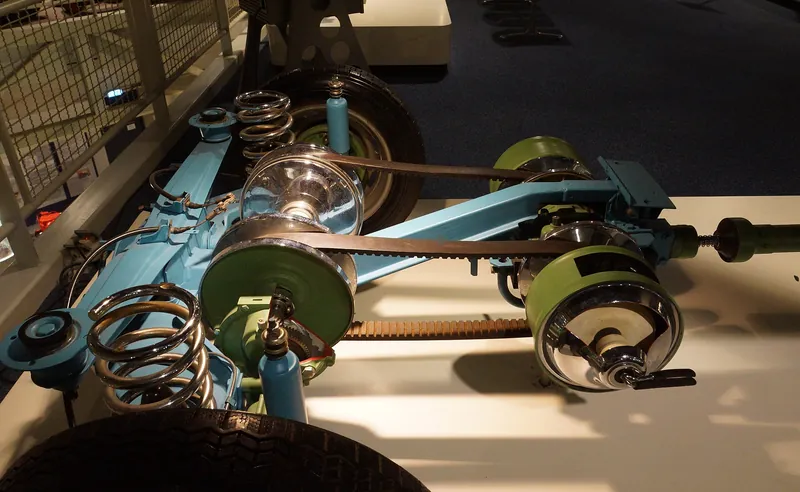
Each pulley is a pair of cone-shaped discs. Move the discs apart and the belt sinks to a small diameter; push them together and it rides out to a large one. DAF Club: Variomatic
In each pair one disc is fixed and one slides: the outer disc on the engine side, the inner disc on the wheel side, so the belt always runs straight. DAF Club: Variomatic
The belt cannot change length, so when it climbs in one pulley it is forced down in the other. That swap of diameters is the gear change. DAF Club: Variomatic
Under full throttle, once near full power, engine speed stays roughly constant while the ratio changes. DAF Club: Variomatic
The layout
Power went from the engine through an automatic clutch and a shaft to the primary box, then through two pairs of discs and two V-belts to two more pairs of discs in the secondary box at the back. DAF Club: Variomatic
On the 600 there were two belts, one for each rear wheel. Driven to Write Autocar describes a separate rubber belt for each rear wheel. Autocar
Bill Vance describes cogged V-belts, with engine vacuum and spinning weights setting the front pulleys while springs worked the rear ones. Bill Vance
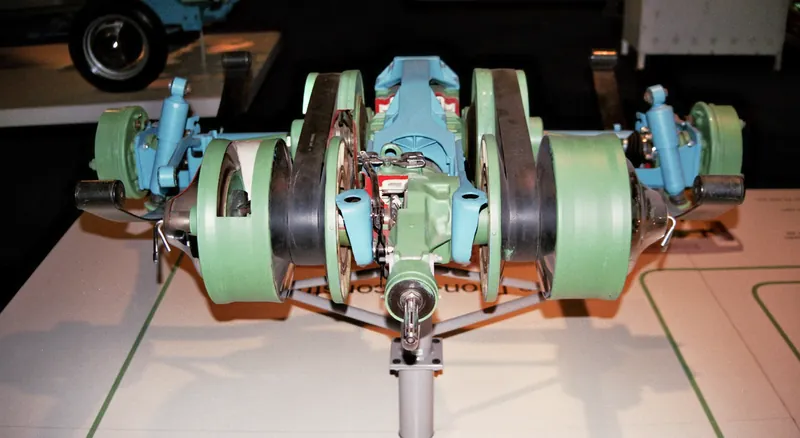
As Commercial Motor put it in 1966, the car was designed round the transmission. Commercial Motor, 1966
What sets the ratio
Three things set the ratio: centrifugal force from engine speed, the pull in the belts, and suction from the engine’s inlet manifold. DAF Club: Variomatic
As engine speed rises, weights inside the front pulleys swing outwards and push the sliding disc in, raising the gearing. DAF Club: Variomatic
On the wheel side a coil spring and a set of disc springs keep the belt squeezed. DAF Club: Variomatic
On a climb, the extra pull in the belts drags them deeper into the front pulleys, and the Variomatic changes down by itself. DAF Club: Variomatic
A diaphragm splits each front pulley into two chambers. Suction in the outer chamber helps it change up; suction in the inner one pushes it to change down. DAF Club: Variomatic
Floor the throttle and the ratio drops for a kick-down; ease off and you get an overdrive effect. DAF Club: Variomatic
Hemmings lists engine torque, throttle-spring pressure, centrifugal force and the filling and emptying of vacuum chambers as the things that worked it. Hemmings
On long descents, suction can be used the other way to hold a low ratio, giving strong engine braking. DAF Club: Variomatic Driven to Write says a switch on the dashboard reversed the vacuum for engine braking on steep hills. Driven to Write
How wide a range
What were the ratios? Sources differ
- For the 600, Bill Vance gives 20:1 for pulling away, rising to 4.4:1. Bill Vance
- Hemmings quotes 14.22:1 to 3.60:1 for one later range. Hemmings
- Depending on the model, the DAF Club gives overall ratios anywhere from 3.60:1 to 28.83:1. DAF Club: Variomatic
These may not conflict: the DAF Club’s range covers every model, from the 600 to the 66, and each had its own gearing.
Two pedals and a lever
A centrifugal clutch took up the drive, so the only lever was a simple forward and reverse selector between the front seats. Hagerty UK
With no gears to change, there was no clutch pedal. Bill Vance
There were only two pedals, accelerator and brake: the driver just steered, pressed the throttle and braked. Martijn Lak
There was no separate reverse gear: DAF simply reversed the drive in the gearbox, so in theory the 600 could go as fast backwards as forwards. Autocar
Later, a Park position that locked the transmission was added to the selector. Driven to Write
A differential without a differential
Two separate belts worked like a differential without having one: the torque split between the rear wheels shifted with the load on each. Commercial Motor, 1966
Driven to Write likens it to a limited-slip differential. Driven to Write
The catch was some rear tyre scrub on full lock; the 66 added a differential to smooth low-speed turns. Driven to Write
Efficiency
DAF told Commercial Motor in 1966 that the transmission was 96 per cent efficient in top gear. Commercial Motor, 1966
An ordinary automatic of the time changed between fixed gears instead: engines.motoring.im explains gears, torque and horsepower. For a very different automatic from the same years, see how the Turbine Car worked on chrysler-turbine.motoring.im.
Living with the belts
How long did a belt last? Sources differ
- At launch, Driven to Write says, DAF claimed the belts had been tested to last at least 80,000 km (50,000 miles). Driven to Write
- But in 1966 DAF told Commercial Motor that on average a car ran over 20,000 miles before the belts needed replacing. Commercial Motor, 1966
A test figure and an average in everyday use are different things, so both can be true. For any particular car, ask an owners’ club.
Belts stretched with use. A warning light came on, and an adjuster under the rear bumper took up the slack. Driven to Write
Belts and pulleys sat open under the car; DAF said stones and mud would simply be thrown off. Driven to Write
Bill Vance flags a possible cold-weather problem: snow or ice fouling the open belts. Bill Vance
Driven to Write calls the system robust, needing no lubrication or regular maintenance. Driven to Write
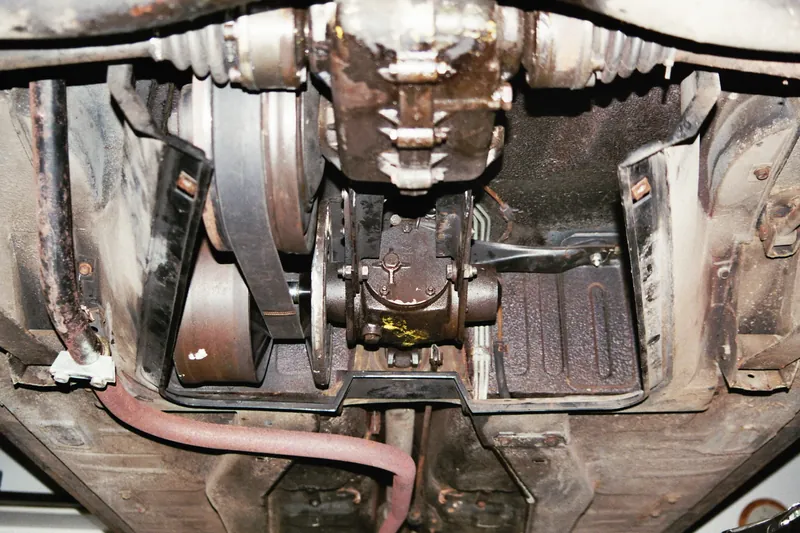
The 46 of 1974, which turned out to be the last real DAF, used a single Variomatic with only one belt. DAF Club: 46
What it was like to drive
Road & Track tested a 600 in 1960 and found the transmission did its job, with revs at full throttle that hardly changed from 10 to 50 mph. Bill Vance
It took 41.5 seconds to reach 50 mph and topped out at 54.5 mph, did 31 to 40 US miles to the gallon, and slowed quickly on hills. Bill Vance
Testers found the very quick steering, 2.2 turns lock to lock, needed constant attention. Bill Vance
Hagerty remembers DAF’s puttering flat twin and its slurring engine note. Hagerty UK
Hagerty UK says the 30 bhp Daffodil took more than 30 seconds to reach 60 mph. Hagerty UK
The DAF Club calls the 600 the first car in the world that needed no greasing, with no lubrication points at all. DAF Club: 600 Bill Vance credits rubber bushes for ending the need for chassis greasing. Bill Vance
Too weak for big engines?
Commercial Motor doubted in 1966 that rubber belts could serve cars of over 50 hp unless most of the torque went through gears. Commercial Motor, 1966
Hemmings says that after retiring in 1965 Hub opened Van Doorne’s Transmissie to work on a second-generation Variomatic with tougher flexible steel belts. Hemmings
How that steel belt turned out is on the what happened page.
Next: the cars that had it →